

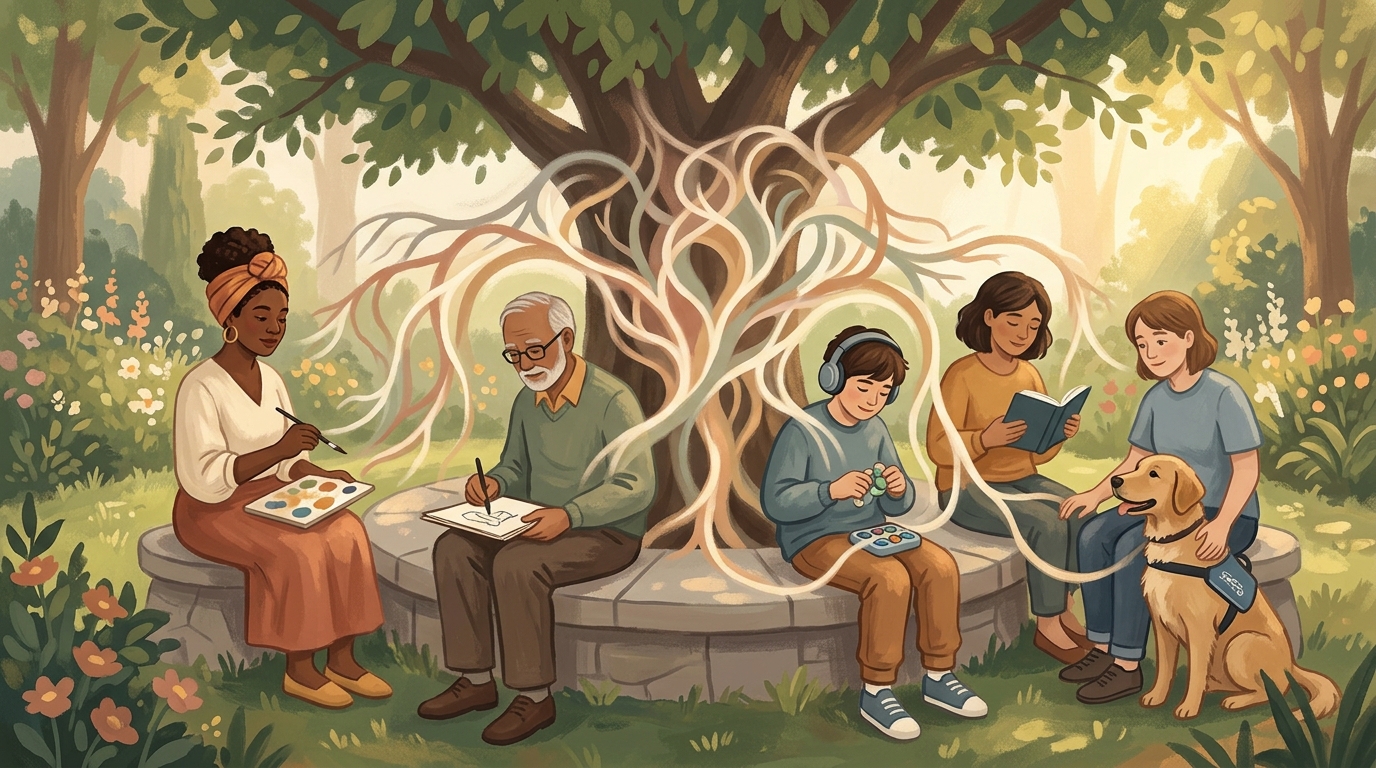
A reflection on stigma, strength, and what we owe the next generation
Stigma rarely arrives with a warning label.
It doesn’t always show up as cruelty or outright discrimination. More often, it slips in quietly, tucked inside a classroom comment, a parent’s sigh, a friend’s eye-roll. “You’re so dramatic. You’re too sensitive. Everyone struggles. You just need to try harder.”
Words like these feel small in the moment. They are not small.
For the millions of young people who are neurodivergent, living with ADHD, autism, dyslexia, dyspraxia, and other cognitive differences, these phrases don’t just sting and fade. They accumulate. They become the internal voice that whispers too often, maybe they’re right at exactly the moment confidence is needed most. And when that voice grows loud enough, it shapes everything: how students engage in learning, how young adults navigate work, and who they allow themselves to become.
It is worth sitting with that truth. Not to dwell in it, but because understanding the real cost of stigma is the first step toward dismantling it.
What stigma actually looks like
We have been taught to think of stigma as visible and dramatic. For neurodivergent youth, it is far more often invisible and insidious. It lives in lowered expectations from some teachers who read slow processing as lack of effort. It lives in the social exclusion that accumulates not through dramatic incidents but through quiet omissions: the group chat you are never added to, the study session no one mentioned, the birthday party where your name simply did not come up.
Research confirms what many neurodivergent people already know from lived experience. Stigma and peer exclusion are strongly associated with higher rates of anxiety and depression, self-harm, lower self-esteem, and reduced academic engagement among autistic and ADHD youth. Students perceived as “different” are 32% more likely to experience bullying than their neurotypical peers.
These are not abstract statistics. They are the daily texture of life for a child who has been told, in countless small ways, that their brain is a problem to be solved.
One of the most painful consequences of that message is masking: the exhausting, often unconscious practice of suppressing natural behaviours, communication styles, and needs in order to appear more acceptable. Masking has been clinically linked to burnout, chronic anxiety, and a profound disconnection from self. And yet for many neurodivergent young people, it feels like the only viable option. Because being authentically themselves has never felt entirely safe, and does not seem ok to others either.
The ripple effects are real, and they last
The impact of stigma does not stop at school gates or dissolve with adolescence.
Data from the National Center for Education Statistics shows that students with disabilities graduate at lower rates than their peers. While many factors contribute to this gap, the role of stigma in shaping self-belief, access to support, and willingness to ask for accommodations is significant and consistently underestimated.
In adulthood, unemployment rates for neurodivergent people are estimated at 30 to 40%, compared to roughly 9% for those without disabilities. Adults with ADHD face disproportionately high rates of job instability and underemployment. Up to 85% of autistic adults with college degrees remain unemployed or underemployed, a figure that should stop us in our tracks.
There is also a financial burden that rarely gets named: the cost of becoming diagnosed in the first place. Formal assessments for ADHD, autism, or dyslexia can run into hundreds or thousands of rands. Add therapy, medication, and specialist appointments, and for families without strong insurance or nearby providers, these costs can delay or entirely prevent access to the support that makes a meaningful difference. Stigma is not only emotionally costly. For many families, it is literally unaffordable.
What we know about neurodivergent strengths, and why it matters
None of this is the end of the story. Not even close.
Research has found that teams including neurodivergent professionals can be up to 30% more productive in certain roles, particularly those requiring pattern recognition, systems thinking, creative problem-solving, and sustained focus. These are not compensations for deficits. They are genuine cognitive strengths, shaped by brains that process the world differently and, because of that, often see what others miss entirely.
Think of the hyperfocus that produces extraordinary depth of expertise. The pattern recognition that identifies what everyone else overlooks. The lateral thinking that arrives at solutions no one else considered. The fierce honesty, the loyalty, the quality of passion that neurodivergent people bring to the things that matter to them.
These traits are not despite neurodivergence. They are part of it.
The tragedy of stigma is not simply that it causes pain. It is that it causes capable, creative, extraordinary people to conceal the very qualities that make them remarkable.
Intent does not erase impact
Most people who say “everyone struggles a little” or “you just need to push through” are not trying to cause harm. That matters, and it also does not change the outcome.
When neurodivergence is framed, however casually, as a personal failing, young people absorb that framing. When it is understood as a natural variation in how human brains work, one that carries both genuine challenges and genuine gifts, something shifts. Students are more likely to seek help, to advocate for themselves, and to imagine futures that feel genuinely within reach.
Changing the narrative, one conversation at a time
Neurodiversity Awareness is not about pity. It is about recognition: recognition of how much has been quietly asked of neurodivergent people who have had to adapt, daily, to systems never designed for them, and recognition of how much everyone gains when we commit to building something better.
Changing stigma starts in the everyday. It means pausing before a throwaway comment. Replacing assumptions with curiosity and understanding. Listening when a young person says they are struggling, rather than offering a fix or a quiet diagnosis of laziness or attitude.
It means understanding that a brain that works differently is not a broken brain. It is a different brain, with different needs, different strengths, and equal potential.
Neurodivergent young people are not waiting to be fixed. They are waiting to be seen, properly and fully, for who they already are.
When we get that right, everything else begins to follow.

