

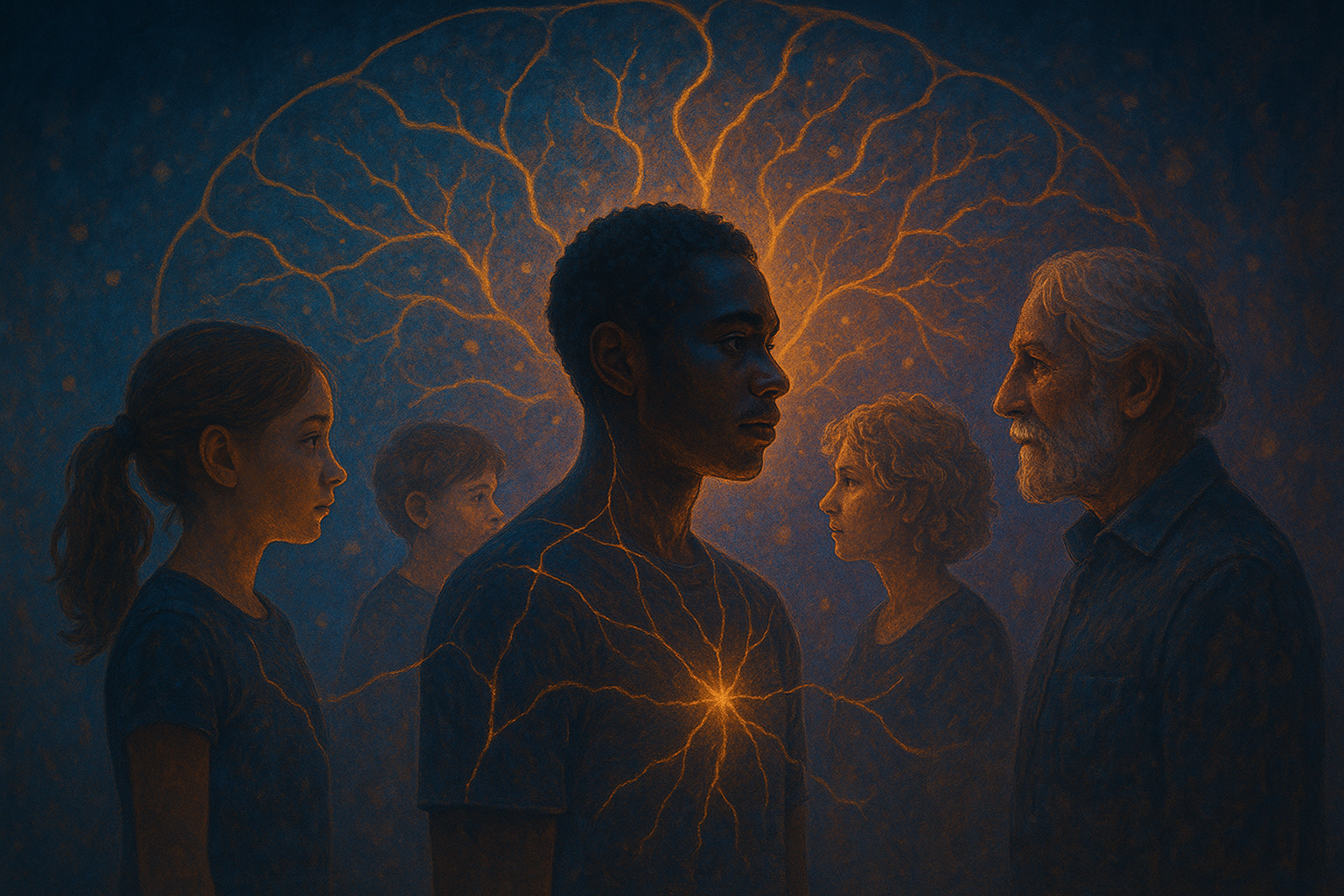
Let’s take a moment. Because today, we’re not just talking about a concept. We’re talking about a quiet, powerful, truth-telling revolution that’s changing how we see ourselves—and each other. Join us as we unpack the answer to the question: What is neurodiversity?
And no, it’s not just a buzzword or the latest social media trend.
Neurodiversity is rooted in biology, not opinion. It’s the (evidence-backed!) understanding that human brains are naturally different—and beautifully so. The way we think, feel, move, sense, communicate, and relate to the world varies from person to person. And just like biodiversity makes ecologies stronger, neurodiversity makes humanity stronger.
This is not just philosophy. It’s science. Decades of research in neuroscience and developmental psychology show that there’s no one “normal” way to have a brain (Armstrong, 2010; Singer, 1998; Milton, 2012). There’s only variation. And that variation matters.
So, What Is Neurodiversity, Really?
Neurodiversity is simply the natural range of how human brains function.
Some people are quick-thinking and intuitive. Others are reflective and deep. Some are attuned to tiny sensory details. Others think in patterns, rhythms, visuals, or movement.
This spectrum of minds is not only valid—it’s vital.
And What Does It Mean to Be Neurodivergent?
Being neurodivergent means your brain processes the world differently from what society considers “typical.” That might mean you’re:
- Autistic
- ADHD
- Dyslexic
- Dyspraxic
- Living with Tourette’s
- Navigating sensory processing differences
- Or shaped by other neurodevelopmental variations
But here’s the key thing: neurodivergence isn’t about labels or deficits.
It’s not about being dis-ordered.
It’s about being different—in real, often invisible ways that the world doesn’t always understand or even ‘see’. So, many neurodivergent people end up hiding those differences, working overtime to appear “normal” – just to fit in.
Let’s Be Clear: Neurodivergent People Are Not Broken
They are the pattern-seers, the deep feelers, the question-askers.
They are:
- The kids who ask “why” until it drives you mad—but whose curiosity is a superpower.
- The non-speaking communicators who express meaning in rich, profound ways that aren’t always verbal.
- The adults who’ve spent years performing, masking, blending in—until they’re exhausted, burnt out, and wondering why it still doesn’t feel right.
- The women and AFAB individuals who were always praised for being helpful and high-achieving, while silently battling anxiety, overwhelm, or sensory overload that no one else saw.
- Those women and men at work who contribute ‘brilliant’ innovations and ‘out the box’ solutions as an ordinary part of their day – but who are … well, just different.
Most were never “too much” or “too sensitive.” The world just didn’t know how to meet them.
The Problem Isn’t the People. It’s the Systems.
Too often, neurodivergent people are told they’re struggling because of who they are.
But the truth?
Most of the struggle comes from a world that wasn’t designed for them.
- Schools still punish difference instead of embracing it.
- Workplaces reward one style of communication, one way of being productive.
- Healthcare often misses women and people of colour who internalise their struggles instead of externalising them.
This isn’t a personal failure.
It’s a design failure.
What If We Looked Through a Different Lens?
Enter the neurodiversity paradigm—a perspective rooted in the social model of disability. It asks us to stop diagnosing difference as a problem, and instead ask better questions:
- What’s getting in the way of this person’s thriving?
- How do we shift the environment—not the person?
What if:
- Classrooms welcomed movement, silence, stimming, and sensory tools as part of learning?
- Workplaces embraced non-linear thinkers and asynchronous work styles?
- Healthcare took masking, burnout, and sensory trauma seriously—especially in adults and late-diagnosed women?
- Communities didn’t just include neurodivergent voices—but centred them?
Because disability doesn’t live in the brain.
It lives in the environment that excludes it.
Late Diagnosis and the Quiet Liberation of Being Seen
For many, discovering they’re neurodivergent later in life is both liberating and heartbreaking.
It explains a lifetime of questions, struggles, and feeling “other.”
It brings grief—for what was missed.
It brings clarity—for what now makes sense.
And it brings something softer, too: the whisper of relief that says,
“You were never broken. You were always whole.”
If You’re Still Reading and Thinking…
“Wait—this sounds like me.”
“I thought it was just me.”
Please know:
You’re not alone.
You never were.
Your difference isn’t a flaw.
It’s your fingerprint.
It’s something to be seen, honoured, and finally—set free.
Let’s build a world where we don’t just tolerate neurodivergence.
Let’s build one where we celebrate it.

